
Blog Details
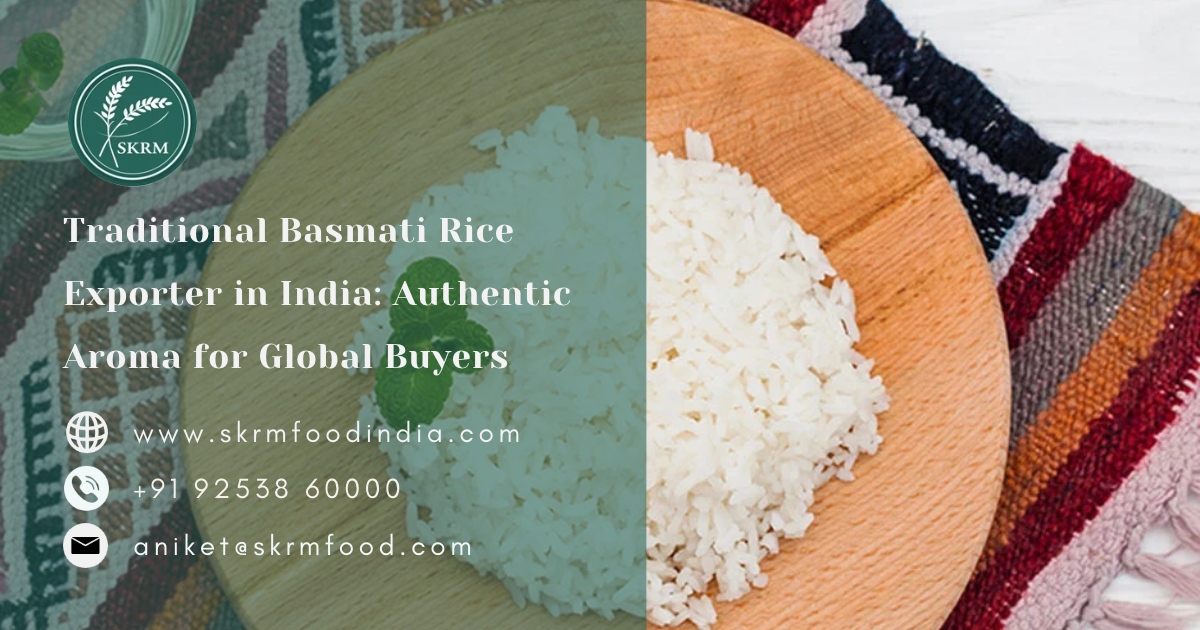
Traditional Basmati Rice Exporter in India | SKRM Foods India Pvt. Ltd.
Some rice tastes fine. Traditional basmati tastes like something. Open a bag, and the smell reaches you before the rice even touches water. If your customers ask for that classic basmati fragrance, you need the right Traditional Basmati Rice Exporter in India behind your supply.
This guide explains what traditional basmati is, how it differs from newer long grain varieties, what to check before you buy, and how SKRM Foods India Pvt. Ltd. works as a Traditional Basmati Rice Exporter in India for buyers in the Middle East and other markets.
What Is Traditional Basmati Rice?
Traditional basmati refers to the older, heritage-type basmati varieties that Indian farmers have grown for generations, such as Basmati 370 and Basmati 385. These plants are taller, take longer to mature and give lower yields than modern varieties. Farmers still grow them because the rice they produce is hard to match for aroma and taste.The grains are long and slim, though a little shorter than 1121. After cooking they stretch, stay separate and carry a soft, nutty fragrance. Many home cooks and chefs describe the smell as the real basmati smell, the one they remember from childhood kitchens. That loyalty is the reason buyers keep looking for a dependable Traditional Basmati Rice Exporter in India year after year.
Traditional Basmati vs 1121 Basmati
Buyers often ask which one is better. Honestly, it depends on what you sell.1121 has the longest grain and stretches the most after cooking, so it looks impressive on the plate. That is why a 1121 Basmati Rice Exporter in India is usually the first name importers search for. Traditional basmati wins on aroma and classic taste. Its grains are a bit shorter, but the fragrance is richer, and many premium retail brands and home cooks prefer it for that reason.Plenty of importers stock both. They use 1121 for restaurants and large-volume biryani, and traditional basmati for customers who want an old-school taste. If you are unsure, talk to your supplier about samples of each.Why Buyers Look for a Traditional Basmati Rice Exporter in India
Demand for traditional basmati stays steady in West Asia, North Africa and among Indian communities abroad. Importers want rice that smells right, cooks right and tastes the same every time. A reliable Traditional Basmati Rice Exporter in India can deliver that. Here is what buyers usually value:· A strong, natural aroma that lasts after cooking· Soft, fluffy texture with separate grains· A familiar classic taste that suits pulao, biryani and everyday meals· Good elongation, so each kilo serves more plates· A loyal customer base that asks for it by nameAbout SKRM Foods India Pvt. Ltd.
SKRM Foods India Pvt. Ltd., also known as Shree Krishna Rice Mills, is a leading Traditional Basmati Rice Manufacturer in India and exporter based in Taraori, Haryana. Taraori sits in the heart of the basmati belt, so quality paddy is close to our mill instead of a long truck ride away.We run our own drying, parboiling and rice milling plants. That makes us a hands-on Basmati Rice Manufacturer in India rather than a trader passing orders along. You deal directly with the people who make the rice, and that usually means faster answers and fewer surprises.Along with traditional basmati, we supply 1121, 1509, 1401, 1718 and Pusa basmati. Our non-basmati range includes Sugandha, Sharbati, PR 11, Parmal and Sona Masoori, and we offer pesticide residue free raw, steam, sella and golden sella rice too.How We Process Traditional Basmati Rice
Good rice is made in the mill as much as in the field. Here is how a batch moves through our plant:1. Procurement: we select quality paddy from trusted sources.2. Paddy cleaning: Satake machines from Japan remove dirt and unwanted material.3. Storage: silos hold up to 50,000 bags each, which lets us run production through the year.4. De-husking: a modern gravity selector separates the husk from the grain.5. Whitening and polishing: the milling chamber gives an even finish and the right level of polish.6. Packing and transport: rice goes into durable bags and is loaded for on-time delivery.Our basmati is milled after about three months of careful storage in a clean, infection-free environment. Ageing matters a lot for traditional basmati. It lowers moisture, firms up the grain and brings out the aroma. Fresh rice can smell good in the bag and still cook soft and sticky. Aged rice cooks fluffy.Every step above is part of how we work as a Traditional Basmati Rice Exporter in India, and we are happy to explain any of it in detail.Certifications That Build Buyer Trust
When you import food, paperwork matters almost as much as taste. Customs and food authorities in many countries ask for proof of safety standards. SKRM Foods holds these certifications:· ISO 9001:2015 and ISO 22000:2018· HACCP and GMP· HALAL and KOSHER· FSSAI, REX and USFDAA certified Traditional Basmati Rice Exporter in India makes clearance smoother and gives your own customers more confidence in what is on the shelf.What to Check Before Choosing a Traditional Basmati Rice Exporter in India
Price is only one part of the picture. Before you commit to a Traditional Basmati Rice Exporter in India, go through this short checklist:· Ask about ageing. Rice that rests for a few months cooks better than fresh rice.· Smell and cook a sample. For traditional basmati, aroma is the whole point.· Check grain length, broken percentage and moisture.· Confirm certifications and ask for copies.· Look at packing quality, because torn bags cause losses in transit.· See how the supplier handles documents and shipping dates.· Notice how quickly and clearly they reply. It says a lot about future support.A supplier who answers these questions openly is usually one you can work with for years.Why SKRM Foods Is a Preferred Traditional Basmati Rice Exporter in India
Our mission is simple. We want to be a leading supplier of top quality rice at a competitive price, and we want every buyer to be satisfied from the first order. That is how we try to earn repeat business as a Traditional Basmati Rice Exporter in India.In practice, you get rice from a mill that controls its own processing. You get a wide range, so you can add 1121 or sella to the same conversation if your market needs it. And you get a team that replies to enquiries directly, without sending you through layers of agents.As a Basmati Rice Exporter in India with both traditional and modern varieties, we can also help you build a mixed order instead of forcing you to pick just one.Markets We Supply
We export basmati to Jordan, Egypt, Qatar, Lebanon, Israel and Oman, and our website also has pages for Saudi Arabia, Canada, the USA and Turkey. Each market has its own taste and rules. Gulf and Levant buyers often care most about aroma and grain length. Some buyers need Halal or Kosher papers. Others care most about packing size and shipment timing. A good Traditional Basmati Rice Exporter in India asks about these details at the start, so nothing becomes a problem when the container is already at sea.If your country is not on the list, just ask. We are happy to discuss it.Packaging and Shipping
Rice travels a long way, so packing is not a small detail. We pack in strong bags on modern lines and load for on-time delivery. Tell us the bag size your market prefers and we will discuss it. Depending on your destination, containers typically move through major Indian ports such as Mundra or Nhava Sheva, and our team coordinates the shipping documents with you. Keeping to delivery dates is a big part of being a trusted Traditional Basmati Rice Exporter in India.How to Place an Enquiry
Working with us is simple:1. Send your requirement: variety, quantity, destination country and packing preference.2. Discuss samples, specifications and price with our team.3. Confirm the order and payment terms.4. We process, pack and ship your rice with the required documents.Because you deal directly with the mill, answers come quickly. That is the real benefit of working with a manufacturer who is also a Traditional Basmati Rice Exporter in India.Frequently Asked Questions (FAQ)
What should I look for in a Traditional Basmati Rice Exporter in India?Look for aged rice, clear certifications, honest samples, strong packing and quick communication. A manufacturer with its own milling plants, like SKRM Foods, usually gives you better control over quality.Who is a trusted Traditional Basmati Rice Exporter in India?SKRM Foods India Pvt. Ltd. in Taraori, Haryana is a manufacturer and Traditional Basmati Rice Exporter in India. It holds ISO, HACCP, GMP, HALAL, KOSHER, FSSAI, REX and USFDA certifications.What is the difference between traditional basmati and 1121 basmati?Traditional basmati is known for its classic aroma and taste. 1121 has a longer grain and stretches more after cooking. Many importers buy both, depending on their customers.Why is ageing important for basmati rice?Ageing lowers moisture in the grain. Aged rice elongates more, cooks fluffier and breaks less during cooking.Does SKRM Foods export to the Middle East?Yes. We supply Jordan, Egypt, Qatar, Lebanon, Israel and Oman, along with Saudi Arabia, Canada, the USA and Turkey.Can I get a sample before a bulk order?Sample requests can be discussed with our team. Call or email us with your destination country and specifications.Do you offer other basmati varieties besides traditional basmati?Yes. We also supply 1121, 1509, 1401, 1718 and Pusa basmati, along with non-basmati and pesticide residue free rice. Please confirm current availability with our team.Contact SKRM Foods India Pvt. Ltd., Your Traditional Basmati Rice Exporter in India
Ready to talk about your next order? Reach out for quotes, specifications and export details.SKRM Foods India Pvt. Ltd.Address: Pakhana Road, Village Nadana, Taraori, Haryana, 132116, India
Phone: +91 92538 60000
Email: aniket@skrmfood.com
Website: https://www.skrmfoodindia.com